Showing posts sorted by relevance for query levithan. Sort by date Show all posts

Friday, December 15, 2006

Wide Awake

by David Levithan

When I first heard about Wide Awake, I immediately put it on my Amazon.com wishlist. I really really liked Levithan's Boy Meets Boy, and the premise of this novel was just plain intriguing: some time in the not-too-distant future, the first gay Jewish president is elected, and it's all thanks to the Jesus Revolution. See, after the Reign of Terror--in which Americans were convinced to fear everything and everyone--and the Greater Depression, a bunch of Christian churches started to ask, "What would Jesus really do?" and they decided that he would love everyone, regardless of race, gender, sexuality, social status, or politics. So gradually the American political climate changes until we get to the present, where the first gay Jewish president has been elected. Except there are still those who cling to old prejudices, one of them being the governor of Kansas, who demands a recall of his state's ballots, therefore putting the president-elect's electoral status in jeopardy.

So I liked the book's premise as much as I knew I would--particularly the way Levithan plays with the intermingling of politics and religion. The problem is that this seems to be the extent of Levithan's unique slant on the topic. A review I read a couple months ago praised Levithan for writing a novel about politics without using the words "Republican," "Democrat," "Conservative," or "Liberal," but regardless of what words he uses, it's clear that this book is talking about Conservatives and Liberals, and the heavily overstated moral of the story is that Liberals are Good and Conservatives are Bad. Which is nice, but thank you very much, I already tend to believe that and I'm not interested in reading fiction that does nothing but pander to my prejudices. I appreciate that you're working so hard to challenge traditional notions of sexuality, Mr. Levithan, but how about doing something to challenge traditional notions of politics beyond flipping the Good Guy and Bad Guy roles (if it can even be argued that you're doing that)? Like, maybe, just perhaps, it's not quite so black-and-white?

The one redeeming moment of this book comes when the main characters are on a bus to Kansas and the fifty-something adults (corresponding more or less to my generation, thirty years from now) stand up and start singing Lauryn Hill's "Everything is Everything." A beautiful moment that almost made the rest of the simplistic-politics-over-story read worth it.

Sunday, August 20, 2006

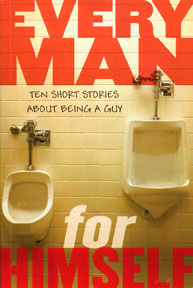
Every Man for Himself

Both the publishing world and I seem to have a thing lately for collections of short stories intended for teenaged guys. On the publishing world's part, I suppose it's a combination of an altruistic intention to get teenaged boys to read and a desire to capitalize on the altruistic intentions of teachers, librarians, and parents to do the same. On my part, it's a little more complicated. Firstly, as a young male librarian I'm expected to be able to recommend books that young male reluctant readers will enjoy. Secondly, these collections tend to include my favorite authors, like Walter Dean Myers, Craig Thompson, Mo Willems, Terry Trueman, and David Levithan. Thirdly and fourthly is a combination of a desire to peek into the world of men and a relatively recent realization that I actually belong in the world of men.

So far, Every Man for Himself: Ten Short Stories About Being a Guy is my favorite of the lot. Guys Write for Guys Read has too much crap that feels like filler and Noisy Outlaws... is just a little on the weird side for my tastes. Good, but weird. Every Man for Himself sticks to only ten stories, so each story has room to develop into a complete piece, and has an amazing line-up of writers (half of which I've mentioned above). Of course, not every story is phenomenal, but even the one I was most disappointed in--a piece by Mo Willems about kids at a superhero high school that had a great premise but fell apart toward the end--was fun to read. My two favorite stories are one by Walter Dean Myers about a kid who lets his friends talk him into auctioning himself off as a prom date, and another by David Levithan about seventeen-year-old Graham, whose almost-thirteen-year-old brother tells their parents that he will not attend his own Bar Mitzvah unless they allow Graham's boyfriend to come--a noble gesture, but now Graham must come up with the boyfriend he doesn't really have.


(out of five)

Wednesday, February 15, 2006

Ghosts of Love
(A Fobby Discourse in Two Parts)

Part I: The Ghost of That Which Never Was

The new elders quorum president in our ward is a recently remarried widower. He doesn’t talk about his first wife all the time, but he does somewhat frequently, when it’s appropriate and applicable to the discussion. When he speaks it’s evident that he misses his first wife immensely and is still very much in love with her. It is also apparent that he loves his second wife immensely and would not give her up for anything. I find myself identifying with him.

Like a widower, I long for someone who is not here, who cannot be here. I ache to hold him, to speak of shared interests and passions, to—as a friend said recently, speaking of a similar yearning—“fall asleep in his arms and wake up next to him.” Occasionally this absent presence takes the form of a tangible individual, but more often it is for that faceless, nameless Man that was never a part of my life.

Like the remarried elders quorum president, this doesn’t change how much I love Foxy J, how happy I am to have her in my life. I love to hold her, to speak of shared interests and passions, to fall asleep in her arms and wake up next to her. Yesterday we ate heart-shaped French toast for breakfast, exchanged small tokens of affection throughout the day, enjoyed a dinner of cheeseburgers and fries that we both had been craving for weeks, and watched Moulin Rouge! together after putting S-Boogie to bed. It was a wonderful Valentine’s Day.

Happiness and longing are not mutually exclusive. I wish I could convey that message as clearly as my widowed friend does.

Like any metaphor, this comparison only goes so far. I did not have my loved one taken from me; I chose this separation, and I could just as easily (which, to be honest, is not all that easily) unchoose it. There are those who would say that what I long for is not a valid love and others who would say that what I have is not a valid love, while few would come to the same conclusion about either of the elders quorum president’s marriages. I cannot honestly say that I know what it’s like to lose a spouse to disease or disaster. But I do have some idea of the emptiness one feels afterward, as well as the joy one can experience concurrently with that emptiness.

Part II: The Ghosts of Love Past, Present, and Future

I just finished Marly’s Ghost by David Levithan. The title page describes it as a remix of Charles Dickens’s A Christmas Carol. Ben, bitter and numb to love after his girlfriend’s death, is visited first by her ghost, then by three other ghosts who show him love in his past, present, and future. As I read, knowing the story would parallel the familiar story of Ebenezer Scrooge, I wondered if it would conclude with Ben finding the true meaning of Valentine’s Day by finding a new lover to share it with. I was wary of this ending because I saw no character who could potentially fill this role so if there was one she’d have to come out of nowhere, and because I couldn’t see Ben going so quickly from despairing over Marly to hooking up with another girl. Thankfully, my fears were unwarranted. The love Ben comes to celebrate at the end of the novel is not so much an exclusive romantic love but more of an all-inclusive platonic love for the people in his life, fed by the memory of his love for Marly. It was nice to see Levithan’s vision of Valentine’s Day as a day to celebrate all kinds of love, not only romantic love.

I’m keenly aware of how many people view Valentine’s Day as a day to remind them of their loneliness, partly because I have so many single friends and partly because several of my students ranted the other day about what a stupid holiday it is. It’s unfortunate that our culture’s emphasis on romantic love leads to so much unhappiness. Yes, romantic love is wonderful--and I appreciated Theric’s post yesterday on why the romance part of romantic love is necessary--but it’s not everything.

“Sure, Master Fob, that’s easy for you to say. You have romantic love. Tell me again why it doesn’t matter that I don’t.”

You’re right. I have no right to speak for single people. But just as I identify to some extent with widowers, I identify to some extent with single people. I know what it’s like to want someone to call your own and who calls you his own, and to know that you may never have that (male) someone. Two big differences: 1. Again, this is my choice; I’ve chosen not to have that male someone. 2. I do have someone to call my own and who calls me her own. And she's probably the best someone I could ever hope for.

This is what I’m trying to say: Because life is life, I experience pain. But it makes me happy and takes away the pain’s sting to love and be loved by Foxy J. It also makes me happy and takes away the pain’s sting to love and be loved by Tolkien Boy and Melyngoch and editorgirl and [insert your name here]. I hope that, whether you have romantic love in your life or not, it makes you happy and takes away your pain’s sting to love and be loved by me.

Friday, December 29, 2006

Another Untitled Post

As part of my training for my new position as an admissions application reader, I've been assessing applications from last year's batch. I came across one yesterday in which the applicant mentioned in his personal statement that he is one of few openly gay students at his high school. That struck a chord with me for the same reason David Levithan's books about openly and happily gay teenagers do--I see in these stories an opportunity missed.

I'm not sure that, even if I had not had my own religious conflict and internalized homophobia to deal with, I could have been openly gay in my high school. Hawaii is a rather liberal and accepting place, but high school is high school. Even the popular kids who everyone knew were gay didn't actually come out until after graduation; my status as a geeky white kid would not have been helped by openness about my orientation. Still, though, the thought of growing up as a teenager in a world where I could have been as comfortable with my sexuality as straight kids are is appealing. Not that any teenager is comfortable with his or her sexuality, but, for example, dating could have been the normally traumatic experience it is for most teens instead of the uniquely traumatic experience it was for me as I tried desperately to fit into the role expected of a straight Mormon boy.

It would be propagandistic of me to say I have no regrets about the life I've chosen for myself. Of course I have regrets. Who doesn't? Looking at my life holistically, I am happy with who I am, but that doesn't mean I don't ache a little every time I see two men holding hands or read about a seventeen-year-old boy resting his head on his boyfriend's chest. Despite the ache, though, and regardless of the happiness I experience as a heterosexually-married husband and father, I'm happy for the kid who felt comfortable enough with himself to be openly gay in high school and to talk about it in his admissions application. I hope he can experience the happiness I do and avoid some of the ache.

Sunday, December 31, 2006

Sidekicks


by Dan Danko, Tom Mason, and Barry Gott

In a very nice email David Levithan sent me in response to my not-so nice review of his latest book, he pointed out that I am a good ten years older than the intended audience (note to self: heed your own advice). Keeping that in mind, I found Sidekicks to be a fun and clever read, so long as I reminded myself that I am at least fifteen years older than its intended audience. Speedy, a fourteen-year-old kid able to run about 85 miles per hour, plays sidekick to Pumpkin Pete, a superhero with a pumpkin head and not much else in the way of superpowers. Speedy is also a member of the Sidekicks, a group of, well, sidekicks. The story plays with superheroes, sidekicks, and supervillains in a humorous if not entirely original way. I enjoyed it.


As I worked on a writing project last night and thought back to my teenaged obsession with superheroes, as well as a discussion on Santorio's blog a few weeks ago, I realized that Batman was the epitome of both of my strongest teenage desires: for man-as-father-figure and for man-as-sexual-object. I envied Robin as much for his role as Batman's adopted son as I did for whatever homoerotic connotations there were to their relationship. This week I read a recent Batman story in which Bruce Wayne offers to legally adopt the latest Robin, Tim Drake. Tim, overwhelmed by the recent loss of not only his father but also his best friend and his girlfriend, falls into Bruce and the two hug. (I might point out that the two are both dressed in tights at this point.) I read this and noted that it was a nice moment, a touching end to the story. I did not, however, obsess over the scene or ache to put myself in Robin's boots.

I think I've managed to grow up over the last ten years, at least a little bit.